
Drought is already shaping daily life for Tribal communities in this region, affecting drinking water, ecosystems, cultural practices, and health. Most participating Tribes don't yet have a drought plan, and funding and technical expertise are the most needed forms of support.
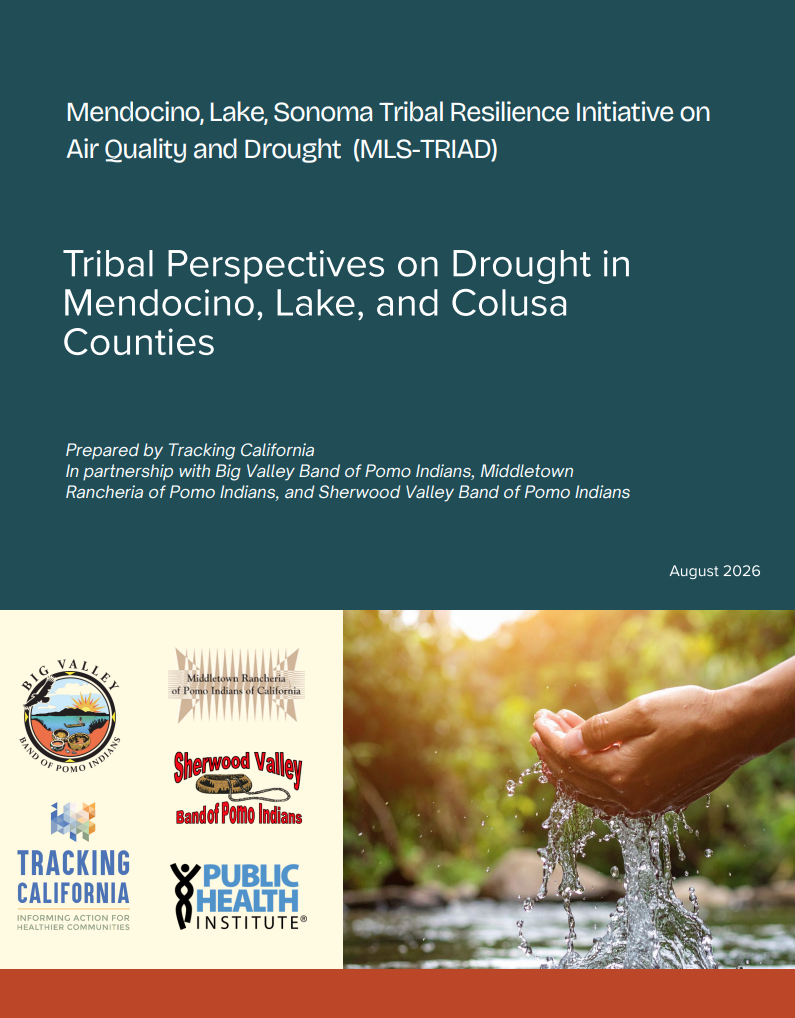
Download the full report (PDF)Download the Resilience Plan Checklist (PDF)
About this project
The Mendocino, Lake, Sonoma Tribal Resilience Initiative on Air Quality and Drought (MLS-TRIAD) is a regional collaborative between Tracking California, Big Valley Band of Pomo Indians, Middletown Rancheria of Pomo Indians, and Sherwood Valley Band of Pomo Indians, funded through the California Governor's Office of Land Use and Climate Innovation.
Between October 2025 and January 2026, MLS-TRIAD conducted one-on-one interviews with nine Tribes and an online survey with environmental staff across 12 Tribes, documenting drought impacts, preparedness levels, water concerns, and shared needs. Because participation was voluntary and limited, findings are illustrative rather than representative of all Tribes in the region. The report offers a snapshot of current conditions and concerns, grounded in the practical realities of Tribal staff responding to drought and multiple competing priorities.
At a glance
| Region | Mendocino, Lake, and Colusa counties, Northern California |
|---|---|
| Tribes involved | 12 (7 in Mendocino, 4 in Lake, 1 in Colusa) |
| Methods | Interviews with 9 Tribes (Oct–Nov 2025) and a survey of 12 Tribes (Nov 2025–Jan 2026) |
| Focus | Drought impacts on water systems, ecosystems, cultural practices, public health, and community planning |
Key Findings
- Drought is a recurring reality. 8 of 12 Tribes say drought affects them very frequently, and half report severe impacts in recent years. Many link drought and wildfire risk, with each intensifying the other.
- Most Tribes don't yet have a drought plan. 8 of 12 Tribes have no drought resilience plan, and no Tribe rated itself "very well prepared."
- Small water systems are the pressure point. Many Tribes rely on Tribe operated water systems, private wells, or a single water source with little backup. Water quality and infrastructure were top priorities.
- Health impacts often go unrecognized. Only 2 Tribes listed public health as a direct drought impact, yet 9 named anxiety, depression, or stress when asked about health. Harmful algal blooms, nitrates, and E. Coli were also concerns.
- Cultural and ecosystem losses are deeply felt. 11 Tribes reported falling water levels in lakes and rivers, and 8 reported impacts to culturally important species and traditional foods, such as the Clear Lake hitch.
- Funding and expertise are the top needs. 9 Tribes named funding support as the most useful kind of help, and 6 named technical expertise in engineering, hydrology, and planning.
What this means for partners and agencies
This report is written for participating Tribes, Tribal environmental programs, and the agencies and organizations that support them. The findings point to practical ways partners can help:
- Plan for the long term, not only emergencies. Drought is becoming a lasting condition, and support for sustained planning goes further than one-time emergency response.
- Support water quality monitoring. Communities on private wells or small systems may lack routine testing, so contamination can go unnoticed.
- Invest in capacity as well as projects. Staff time, technical expertise, and access to data are often what stand between Tribes and available funding.
- Treat cultural and ecosystem impacts as part of drought. Resilience includes ceremonial uses, traditional gathering, fishing, hunting, and land stewardship practices through which knowledge and ways of life are passed from one generation to the next, not only water supply.
- Strengthen coordination. Several Tribes named limited coordination with agencies a barrier. Connecting Tribes to programs such as the State Water Board's SAFER program is one concrete step.
The full report also includes a Tribal Drought Resilience Plan Checklist (Appendix A) and county-level survey results for Lake and Mendocino counties (Appendices B and C).
Download the full report (PDF)
Thank you to the participating Tribes
Big Valley Band of Pomo Indians, Cahto Tribe of the Laytonville Rancheria, Coyote Valley Band of Pomo Indians, Habematolel Pomo of Upper Lake, Kletsel Dehe Wintun Nation, Middletown Rancheria of Pomo Indians, Pinoleville Pomo Nation, Potter Valley Tribe, Redwood Valley Little River Band of Pomo Indians, Scotts Valley Band of Pomo Indians, Sherwood Valley Band of Pomo Indians, and Yokayo Tribe of Indians.
Questions?
Contact Tracking California at info@trackingcalifornia.org for more information, or to request the interview guide or survey instrument.