
People experiencing homelessness have been historically excluded from California's environmental health data. Because county-level rates for conditions like asthma, COPD, heart attacks, and heat-related illness require a patient's county of residence — information that unhoused patients cannot reliably provide — these encounters have been treated as "missing data" and dropped from public health surveillance.
A 2019 change in California hospital coding practices, driven by Senate Bill 1152 and HCAI directives, made it possible for the first time to identify unhoused patients in discharge records and quantify their exclusion. Tracking California's recent data briefs use this improvement to make a previously invisible population visible — and the picture that emerges has significant implications for how California measures, plans for, and responds to environmental health risks.
Homelessness and Environmental Health in California
People experiencing homelessness in California face a distinct and compounding set of environmental health risks. Without consistent access to air-conditioned indoor spaces, shaded shelter, or drinking water, unhoused individuals are more exposed to extreme heat, poor air quality, wildfire smoke, and the cardiovascular and respiratory stress these conditions produce. Outdoor sleeping, physical labor in hot conditions, and high rates of pre-existing chronic illness further increase susceptibility. As climate change drives more frequent and intense extreme heat events across the state, these risks are growing — and they are not evenly distributed across the unhoused population.
California's unhoused population is also demographically distinct from the housed population. It is disproportionately male, disproportionately African American/Black, and concentrated among working-age adults rather than children or elderly adults. These demographic patterns matter because they shape which communities bear the greatest burden when environmental health surveillance systems leave unhoused patients out of the count.
A Long-Standing Gap in California's Health Data
Tracking California has calculated the CDC's Nationally Consistent Data and Measures (NCDMs) — rates of emergency department visits and hospitalizations for asthma, COPD, heart attack, and heat-related illness — at the county level for nearly 25 years, using hospital discharge data from the California Department of Health Care Access and Information (HCAI). Because county-level rates depend on where a patient lives, encounters for patients without a valid California county of residence have been excluded. This category includes patients experiencing homelessness, out-of-state visitors, and records with missing or invalid address data.
For most of that history it was impossible to know how many of these "missing" records belonged to which group. California hospitals could record homelessness using a patient ZIP code of "ZZZZZ" or the ICD-10-CM diagnosis code Z59.0, but those codes were applied inconsistently. Without reliable coding, an unhoused patient and a tourist looked the same on paper: a record with no California county of residence, dropped from the rate.
That changed in 2019. In response to HCAI directives and the passage of Senate Bill 1152, California hospitals began documenting homelessness in discharge records more consistently. The definition of homelessness in the data didn't change — but how reliably it was captured did. For the first time, analysts can separate unhoused patients from out-of-state visitors and data errors, and quantify how much of the surveillance gap is attributable to homelessness.
What the New Data Reveals
Tracking California's analysis of 2019–2020 HCAI data, summarized in the three briefs below, shows that:
- Most patients excluded from California's environmental health NCDMs are people experiencing homelessness, not data errors or out-of-state visitors. For COPD, nearly 4 in 5 excluded records are from unhoused patients.
- Heat-related illness has the highest exclusion rate of any tracked condition — more than 1 in 10 ED visits are missing from county-level rates.
- Excluded patients are disproportionately male, Black, and working-age, meaning published rates systematically undercount the communities bearing the greatest burden of environmental health conditions.
- Unhoused Californians accounted for nearly 1 in 10 heat-related ED visits in 2019–2020, despite representing less than 0.4% of the state's population — making them roughly 22 times overrepresented in heat-related ED visits relative to their population share.
- On extreme heat days, unhoused individuals were 38% more likely than the general population to visit the ED for heat-related illness, and 11% more likely for cardiorespiratory illness. Black individuals and seniors among the unhoused face the highest risk.
These findings have direct implications for how local health departments interpret published NCDMs and plan heat response, cooling center placement, and outreach.
Related Data Briefs
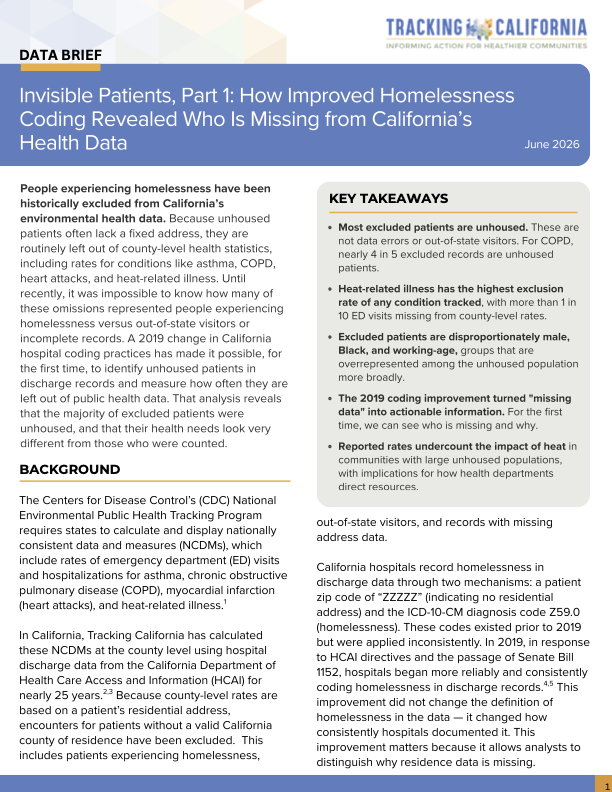
Invisible Patients: How Improved Homelessness Coding Revealed Who Is Missing from California's Health Data
This brief quantifies the exclusion of unhoused patients from county-level NCDMs for asthma, COPD, heart attack, and heat-related illness, and shows how the demographic profile of excluded patients differs strikingly from those who are counted.
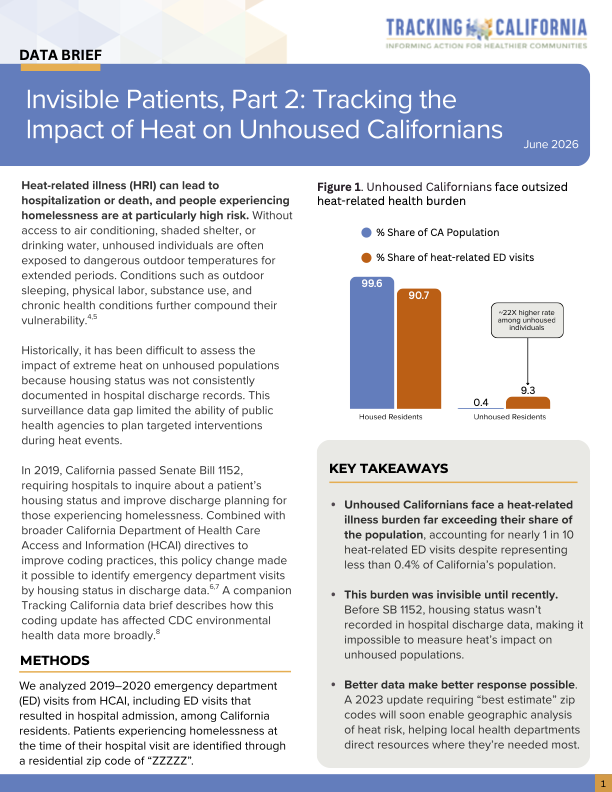
Tracking the Impact of Heat on Unhoused Californians
Applying the improved coding to heat-related illness, this brief characterizes the demographic burden of heat on California's unhoused population.
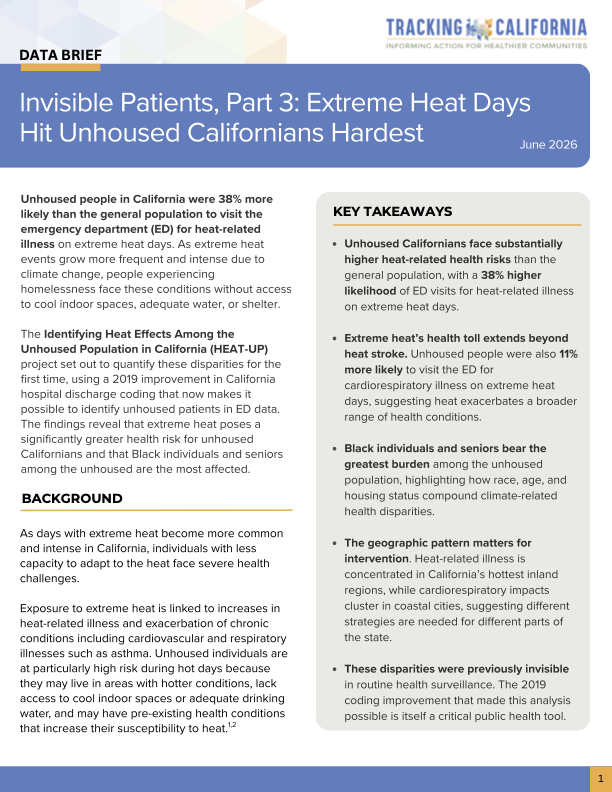
Extreme Heat Days Hit Unhoused Californians Hardest
The HEAT-UP (Identifying Heat Effects Among the Unhoused Population) project links ZIP Code-level heat exposure data to hospital discharge records to measure how extreme heat days affect unhoused Californians.
Related Projects

Further Reading
- McConville S, Kanzaria H, Hsia R, Raven M, Kushel M. How Hospital Discharge Data Can Inform State Homelessness Policy. Public Policy Institute of California; 2022. https://www.ppic.org/publication/how-hospital-discharge-data-can-inform-state-homelessness-policy/
- HCAI. Inpatient Hospitalizations and Emergency Department Visits for Persons Experiencing Homelessness in California: Patient Demographics By Facility; 2022.
- Gronlund CJ. Racial and socioeconomic disparities in heat-related health effects and their mechanisms: a review. Curr Epidemiol Rep. 2014;1(3):165–173.
- Ramin B, Svoboda T. Health of the homeless and climate change. J Urban Health. 2009;86(4):654–664.
- U.S. Interagency Council on Homelessness. California Homelessness Statistics. https://www.usich.gov/
- CDC Environmental Health Tracking Branch. Standards for Nationally Consistent Data and Measures within the CDC's National Environmental Public Health Tracking Network; 2017. https://www.cdc.gov/nceh/tracking/pdfs/ncdm_requirements_april2017.pdf